
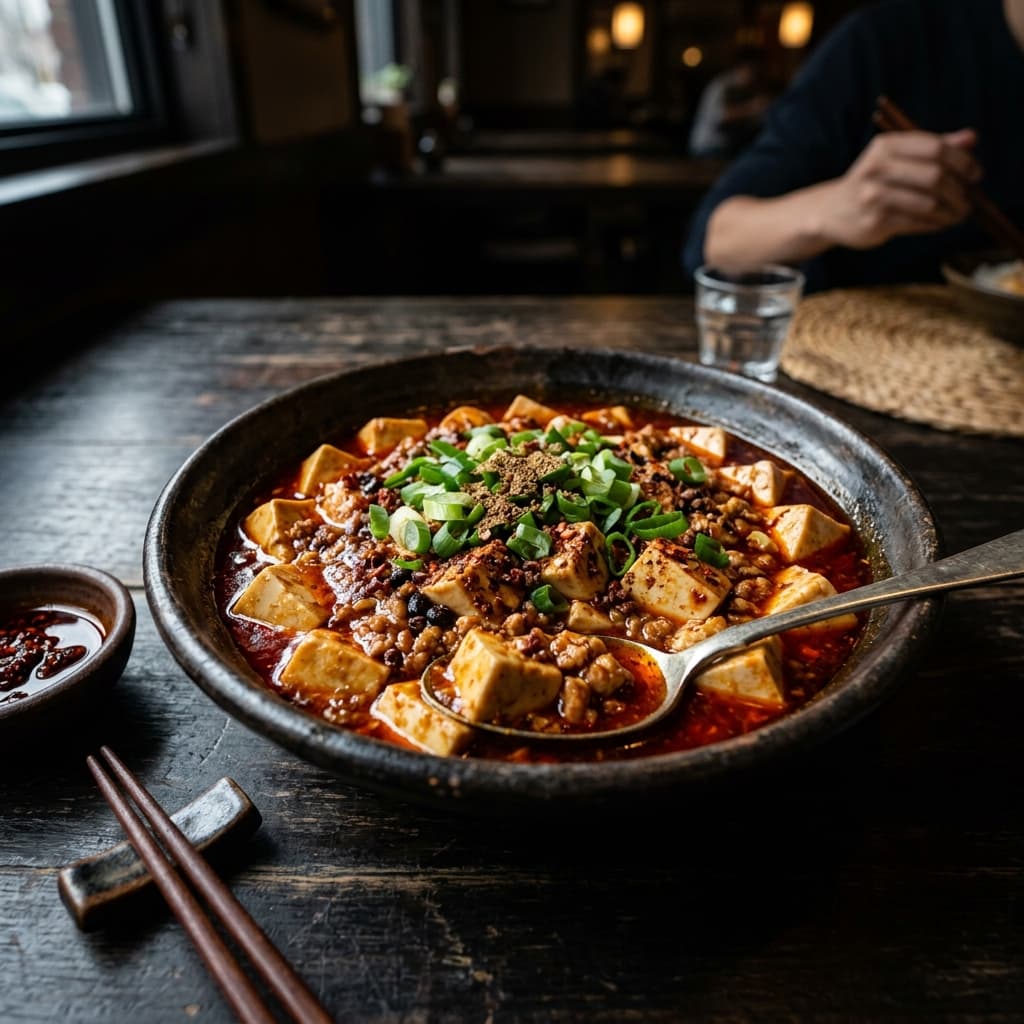
Doubanjiang (豆瓣酱) is fermented broad bean and chili paste from Pixian, Sichuan — the foundational ingredient in mapo tofu, twice-cooked pork, and most authentic Szechuan dishes. A guide to what it is, how it's made, and what makes it irreplaceable.
Doubanjiang (豆瓣酱, pronounced doh-ban-jyang) is a fermented paste made from broad beans, dried chilies, salt, and wheat flour, originating in Pixian county, Sichuan province, China. It is the single most important ingredient in Szechuan cuisine — described by Chinese cooks as “the soul of Sichuan cooking.” Doubanjiang provides the deep red color, umami depth, fermented funk, and chili heat that define dishes like mapo tofu, twice-cooked pork, and fish-fragrant eggplant. Unlike most condiments, it is not a finishing sauce — it is cooked directly in hot oil early in the recipe, transforming and releasing flavor compounds before any other ingredients are added.
Where Does Doubanjiang Come From?
The definitive variety, Pixian doubanjiang (郫县豆瓣, also spelled Pixian douban), comes from Pixian county near Chengdu. Legend traces its creation to a merchant from Fujian who arrived in Sichuan around 1688, attempted to preserve broad beans in a jar, and discovered that the combination of beans, salt, and Sichuan humidity produced an exceptionally flavorful fermented paste.
Today, Pixian county produces more than 200,000 tons of doubanjiang annually. Premium versions are aged for three to five years in open clay crocks that are stirred and sun-dried daily — a process that produces complex flavor through prolonged lacto-fermentation and oxidation. Pixian doubanjiang received China's Geographical Indication protection in 2005, meaning only paste produced in Pixian can legally carry the name.
What Does Doubanjiang Taste Like?
Doubanjiang has a layered, intense flavor profile: salty, deeply savory (umami from fermentation-produced glutamates), moderately spicy from dried chilies, and pungently fermented — similar in earthiness to miso but with chili heat. The fermented broad bean base contributes thick, persistent umami that no fresh ingredient can replicate. Fresh doubanjiang is reddish-brown; aged three-plus years it becomes a deeper brick red with a more complex, less sharp flavor.
When cooked in hot oil — the standard technique — the paste darkens, the raw fermented edge rounds out, and its compounds infuse the oil, turning the cooking fat a characteristic Szechuan red. This oil carries flavor throughout the entire dish.
How Is Doubanjiang Made?
- Broad beans (fava beans) are hulled, soaked, and mixed with wheat flour, then inoculated with mold (Aspergillus oryzae) to begin fermentation
- Dried chilies are combined with salt and fermented separately for several months
- The fermented beans and chili-salt mixture are combined in large clay crocks
- The crocks are left open to the air and stirred daily for a minimum of one year, up to five years for premium grades
- Sun exposure and daily stirring drive oxidation and flavor development through the Maillard reaction
The result contains enzymes, amino acids, and organic acids produced by bacteria and yeasts, which together create the paste's signature depth. Industrially produced doubanjiang shortens fermentation to weeks using temperature control; it is noticeably thinner in flavor.
Doubanjiang vs. Other Chinese Bean Pastes
| Paste | Base Bean | Flavor | Use |
|---|---|---|---|
| Doubanjiang | Broad bean | Salty, spicy, fermented, umami | Cooked in oil; Szechuan cooking |
| Hoisin sauce | Soybean | Sweet, thick, mild | Finishing glaze; Cantonese dishes |
| Tianmian sauce | Wheat/soybean | Sweet, mild fermented | Beijing duck, Mandarin dishes |
| Doenjang (Korean) | Soybean | Pungent, fermented, no chili | Korean stews, dipping |
| Japanese miso | Soybean | Mild to medium umami, no heat | Soups, marinades |
No substitution replicates doubanjiang. Combining miso with chili paste, or using gochujang (Korean chili paste), produces a different flavor — less fermented bean depth, different heat character.
Which Dishes at China Jade Use Doubanjiang?
- Mapo Tofu (麻婆豆腐) — doubanjiang is the primary sauce base; cooked in oil before the tofu is added
- Twice-Cooked Pork (回锅肉) — pork belly stir-fried with doubanjiang, leeks, and fermented black bean
- Dan Dan Noodles (担担面) — in the spiced pork sauce
- Fish-Fragrant Eggplant (鱼香茄子) — forms the sauce base despite containing no fish
- Szechuan String Beans (干煸四季豆) — dry-fried beans finished with doubanjiang and garlic
- Kung Pao Chicken (宫保鸡丁) — used in the braising sauce along with dried chilies
At China Jade, we use Pixian doubanjiang — the Geographical Indication-protected variety from Sichuan province — in all dishes that call for it. Most Chinese-American restaurants in the D.C. suburbs substitute generic chili bean sauce, which lacks the fermented broad bean depth that gives Szechuan dishes their characteristic flavor.
Authentic vs. Substituted Doubanjiang
Many restaurants outside China use “chili bean paste” — a generic category that may contain no broad beans and minimal fermentation time. The result is a one-dimensional chili heat without the glutamate depth that fermented broad beans contribute. Dishes taste spicy but flat. Authentic Pixian doubanjiang adds what food scientists describe as a “fourth dimension” of savory flavor — the same fermentation-driven complexity found in aged cheese, soy sauce, and wine.
Our head chef has sourced Pixian doubanjiang continuously for over 30 years. It is the reason mapo tofu and twice-cooked pork at China Jade taste different from the same dishes elsewhere in the D.C. metro area.
Visit China Jade
Taste doubanjiang in Mapo Tofu, Twice-Cooked Pork, or Dan Dan Noodles at China Jade. Open daily 11 AM–9 PM at 16805 Crabbs Branch Way, Derwood MD.
View Our Menu →